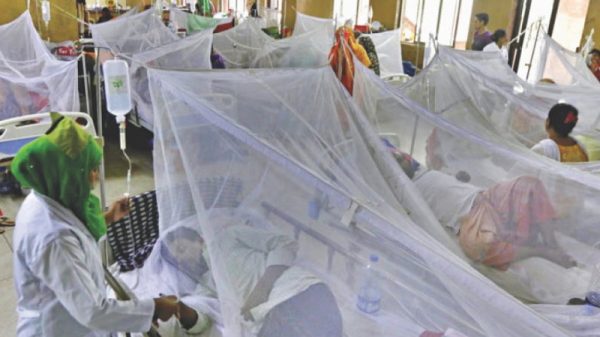
Children with dengue fever lie on beds at Mugda Medical College and Hospital in Dhaka on Sunday. | New Age photo Daily newspaper subscription
The dengue situation has taken an alarming turn as deaths and hospitalisations continue to rise across the country in the absence of effective measures by the authorities to contain the Aedes mosquitoes responsible for the viral disease.
The country on Sunday recorded this year’s highest single-day dengue death toll, with 12 people dying and 740 others hospitalised with the fever in the 24 hours till 8:00am on the day, according to the Directorate General of Health Services.
With the latest fatalities, the number of deaths from the mosquito-borne disease has risen to 57 in the first 21 days of September. The month has already become the deadliest in the year for the mosquito-borne disease.
Meanwhile, dengue hospitalisations in the capital surpassed those in Barishal, which earlier dominated the country’s dengue caseload this year.
Those who died in the 24 hours ending 8:00am on Sunday include five each in Dhaka and Barishal divisions and one each in Chattogram and Mymensingh divisions.
In the 24 hours, 384 dengue patients were hospitalised in Dhaka, 165 in Barishal division, 77 in Chattogram, 52 in Khulna, 22 in Mymensingh, 28 in Rajshahi, three in Rangpur, and nine in Sylhet division.
The country has so far reported 179 dengue deaths and 41,831 cases this year.
At least 39 patients died of dengue in August, 41 in July, 19 in June, three in May, seven in April, three in February and 10 others died of dengue in January, according to the DGHS data.
The data showed that the viral fever sent 1,161 people to hospitals in January, 374 in February, 336 in March, 701 in April, 1,773 in May, 5,951 in June, 10,684 in July and 10,496 in August.
Public health experts, however, believe that the actual number of cases and fatalities is considerably higher than reported, as the health services collect data only from selected hospitals.
They have repeatedly cautioned that without stronger vector-control measures, improved data collection, and better-equipped hospitals, the crisis may continue to spiral.
An analysis of DGHS data shows that until the 30th endemic week — mid-July —at least 15,585 hospitalisations and 58 deaths were recorded.
Of them, Barishal alone reported 6,407 hospital admissions, while Dhaka logged 3,333, placing Barishal at the top, followed by Dhaka and Chattogram.
But the pattern changed a few days ago. Between the 30th and the current 39th endemic week, a total of 25,124 new hospital admissions and 109 deaths were reported.
Of these, Dhaka accounted for 7,227 admissions, overtaking Barishal, which recorded 5,520 during the same period. Chattogram ranked third.
The DGHS update further indicates that dengue infections have expanded across the country.
Mosharraf Hossain, 55, of the capital’s Kanthalbagan area, said that he did not see any anti-mosquito drive in his area in a week.
The residents in Mohammadpur, Kalayanpur, Green Road, Basabo, and in parts of the old city like Narinda, Bangshal and Jatrabari also said that they very occasionally saw anti-mosquito drives in their areas.
Officials at two city corporations in Dhaka, however, claimed that they had strengthened their anti-mosquito activities within their limitations.
They said that the city corporation was spraying larvicide in the morning and using fogging in the evening to control the aedes mosquito.
Entomologists feared that dengue cases might increase more in Dhaka as infected aedes mosquitoes are there with huge breeding potential.
An epidemiologist and former director of the Institute of Epidemiology, Disease Control and Research AM Zakir Hussain said that the Aedes were getting suitable rain and temperature for more breeding now.
‘Dengue usually peaks in July, but this year rain has continued into September. We fear cases will not come under control immediately. Numbers may only begin to fall slowly from October,’ he said.
National Institute of Preventive and Social Medicine professor and an entomologist Golam Sarwar said that the authorities should now start hospital-centric crash programme and patient tracing.
He said that if the authority could not control the situation immediately, it would bring more suffering for the residents and fatalities as well.
In the backdrop of the increasing trend of dengue infection, the health directorate on September 16 issued a 12-point directive asking hospitals to prioritise dengue treatment.
It asked hospitals to form specialist-led medical boards to supervise dengue and chikungunya treatment.
ICU support must be prioritised for critical patients while suspected cases should receive urgent NS1 tests and round-the-clock diagnostic and treatment services.
It also instructed hospitals to allocate designated wards or spaces for admitted dengue patients and assign dedicated doctors and nurses under the medical board for exclusive care.
Bangladesh has faced recurring dengue outbreaks since its first official appearance in 2000, when 93 people died and 5,551 were hospitalised.
The situation has worsened in recent years. Dengue claimed 1,705 lives and led to 321,179 hospitalisations in 2023 alone, compared with 853 deaths and 244,246 hospitalisations in the entire period between 2000 and 2022.
In 2024, the country suffered another severe wave, with 575 deaths and 101,214 reported cases.